Don’t choose their future. Help them discover it.
Career exploration doesn’t begin with having the right answer. It begins with seeing possibilities, asking questions and talking about what makes a young person curious.
A young person cannot seriously consider a career they have never had the opportunity to see.
Start Here
Let’s spark a conversation.
Career discovery works better when everybody gets to ask questions. These aren’t questions with right or wrong answers. They’re simply ways to learn more about each other.
Parents & guardians — ask them.
Try listening for the things that make them light up rather than trying to match them immediately with a job title.
Young people — ask them too.
Parents and guardians have experiences you may never have heard about. Ask them about their own career journey.
Look For Clues
Interests often appear before career titles do.
A young person may not know what occupation interests them, but they may already be showing you how they like to think, learn, solve problems and contribute.
Ask, “What kinds of things make you curious?”
A Simple Place To Begin
You don’t need a job title to start exploring.
Start with the kind of contribution that interests them. Trade Tracks PATH provides four doors into a much larger world of careers.

Produce
Grow, harvest, extract, prepare and create the food, materials and resources people depend on.
Explore Produce →
Assemble
Build, construct, fabricate, install, connect, manufacture and put things together.
Explore Assemble →
Transport
Move people, products and equipment — and keep transportation systems operating safely.
Explore Transport →
Help
Serve, care, support, protect and help people, workplaces and communities function.
Explore Help →There Is No Single Route
Their future does not have to be decided today.
Career exploration is a process. A useful next step is often more important than trying to make one enormous lifelong decision.
See
Discover occupations and industries they may never have encountered before.
Try
Experience tools, activities, courses, workplaces and hands-on learning.
Explore
Compare careers, workplaces, education pathways, skills and possibilities.
Take a next step
Choose the next useful experience without believing it has to determine an entire lifetime.
Explore Before Graduation
High school can be part of career discovery.
Ontario students can explore workplaces, industries, apprenticeship and postsecondary pathways while they are still completing secondary school.
Ontario Youth Apprenticeship Program
Explore how students can begin discovering apprenticeship and skilled-trades opportunities while still in secondary school.
Explore OYAP → Workplace LearningCooperative Education
Connect classroom learning with real workplaces, occupations, employers and practical experience.
Explore Cooperative Education → Sector ExplorationSpecialist High Skills Major
Explore a particular economic sector while completing the Ontario Secondary School Diploma.
Explore SHSM → Secondary + PostsecondaryDual Credit
Discover opportunities that can connect secondary-school learning with college and other postsecondary experiences.
Explore Dual Credit →After High School
There is more than one way into a skilled career.
Many families only hear about university. Skilled careers have several entry points, and young people can combine them, change direction or add more education later.
Apprenticeship
An apprentice is a paid employee who learns a trade on the job from experienced tradespeople, with short blocks of in-class training. Wages rise as skills grow. Most apprenticeships lead to a Certificate of Qualification, and many to a Red Seal.
Start with OYAP in high school → Classroom + ShopCollege & Trade School Programs
Ontario colleges and training providers offer certificate, diploma and pre-apprenticeship programs. These build skills and hands-on experience before, or alongside, an apprenticeship.
Browse the Ontario directory → Start WorkingEntry-Level Work
Some young people start as a general labourer, helper or trainee with an employer who may later sponsor them as an apprentice. Real workplace experience is often the best career test.
See employers & opportunities →Choosing a trade does not close any doors. Many tradespeople later add college or university education, move into supervision, inspection, teaching or estimating, or start their own business.
Plain-Language Guide
What do these words mean?
Skilled-trades conversations come with a lot of new terms. Here is what you are most likely to hear from schools, colleges and employers.
- Skilled trade
- An occupation learned mainly through hands-on training and practice, such as electrician, plumber, automotive service technician, cook, hairstylist or welder.
- Apprentice
- A person registered to learn a trade through paid on-the-job training with an employer (the sponsor), plus periods of in-class learning at a college or training centre.
- Journeyperson
- A fully qualified tradesperson who has completed an apprenticeship and passed the certification exam for their trade.
- Red Seal
- An interprovincial standard of excellence. A Red Seal endorsement lets a qualified tradesperson have their credential recognized across Canada.
- Compulsory trade
- A trade where, by law, workers must be a registered apprentice or hold a certificate to do the work (electrician and plumber are examples).
- Skilled Trades Ontario
- The provincial agency that sets apprenticeship training and certification standards and issues certificates in Ontario.
- Co-op (Cooperative Education)
- A high-school course in which students earn credits by learning in a real workplace under the supervision of a teacher and an employer.
- OYAP
- The Ontario Youth Apprenticeship Program. It lets high-school students explore, and sometimes register in, an apprenticeship through co-op while still earning their diploma.
- SHSM
- Specialist High Skills Major. A bundle of high-school courses, certifications and experiences focused on one sector, recognized with a red seal on the diploma.
- Dual Credit
- A college or apprenticeship course taken while in high school that counts toward both the high-school diploma and a college credential.
Who Can Help
You don’t have to have every answer.
These people can explain options, eligibility and next steps for your young person’s school and community.
Guidance counsellor
Course selection, graduation requirements, college and apprenticeship applications.
Co-op or OYAP teacher
Workplace placements, OYAP eligibility and how credits work at your school board.
A tradesperson
What the work is really like. Ask someone you know, or meet people at the Showcase.
Bring The Conversation With You
See careers together.
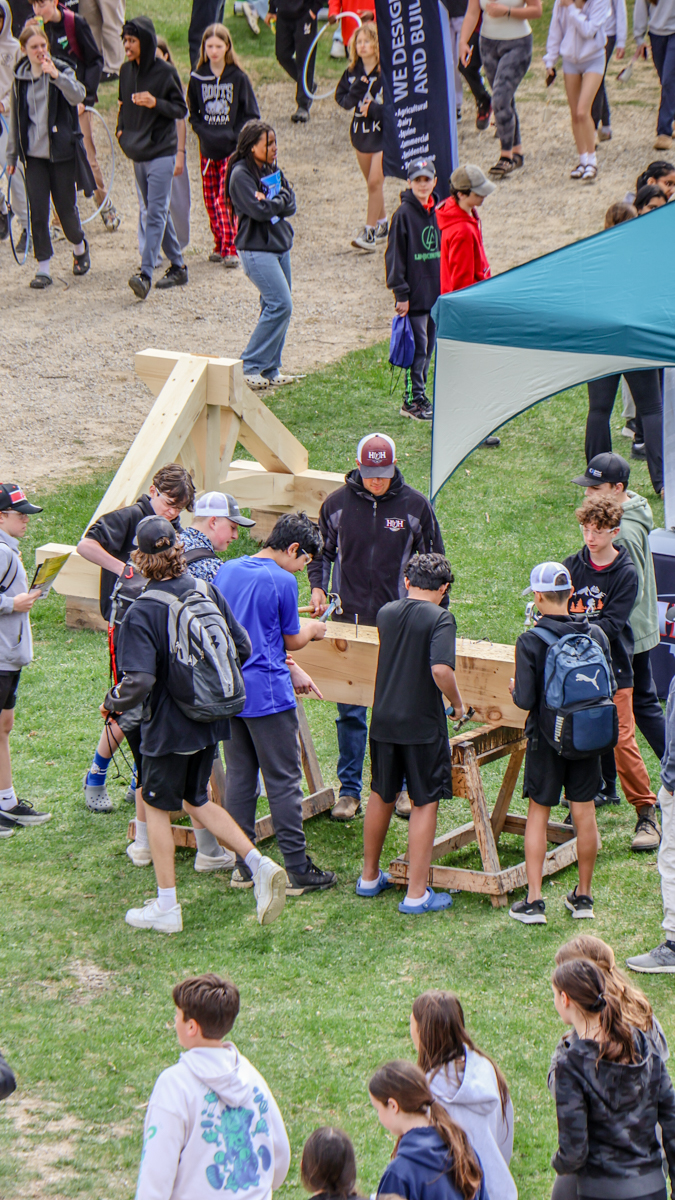
Meet the people who do the work. Watch demonstrations. See tools, equipment and technology. Ask questions together. Then talk about what caught your attention.
Keep The Conversation Going
You don’t have to figure it all out today.
Explore a career. Follow another question. Compare possibilities. Come back later and look again. Interests change as young people gain experience and discover more of the world around them.